


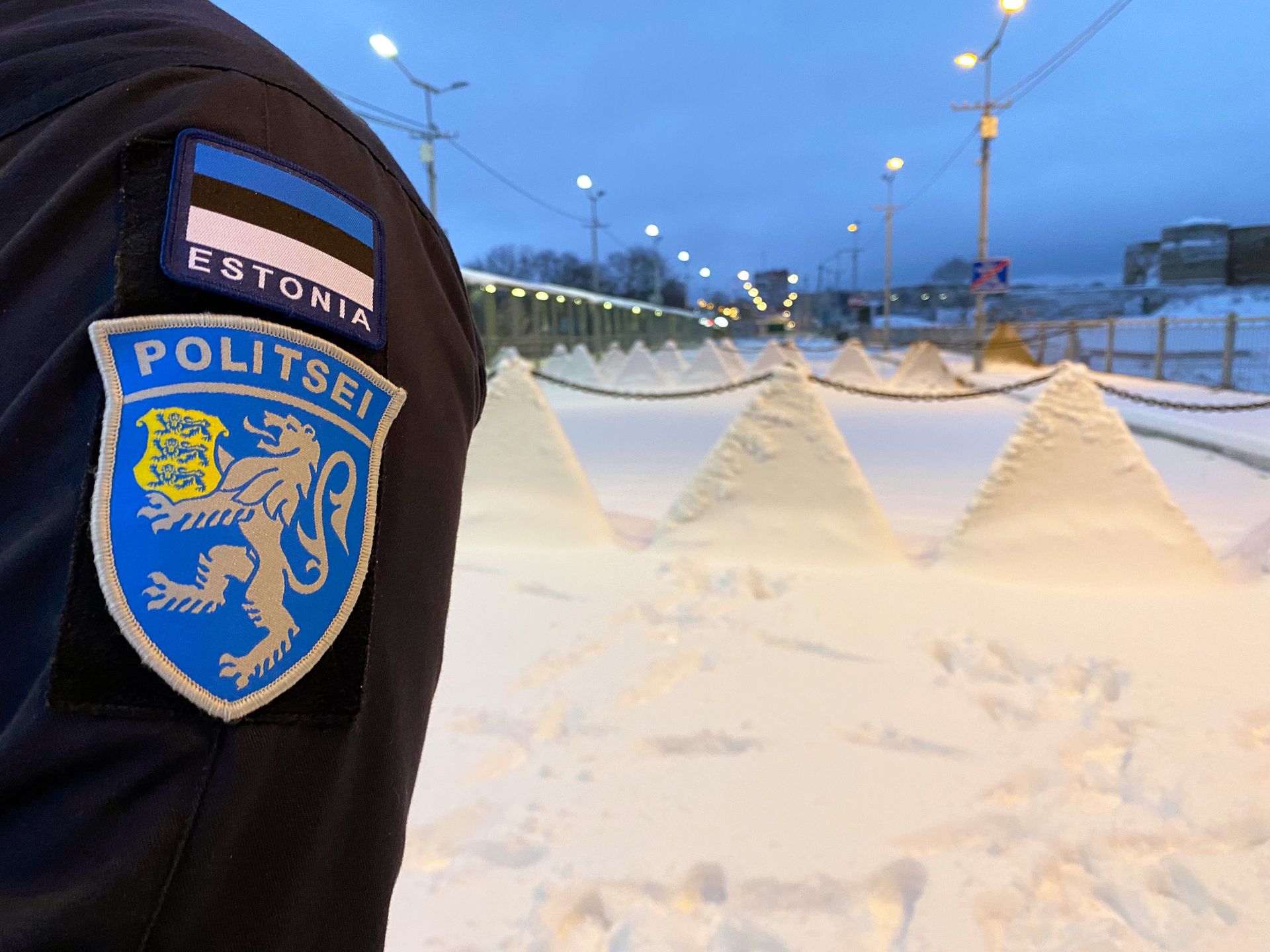
The new Iron Curtain is a digital wall running along the border between NATO-member countries and Russia. Historically, NATO defined the domains of its military operations as sea, land and air. Today, there are two new domains — space and cyberspace. Estonia, a small country bordering Russia with a population of less than 1.4 million, was, during the Cold War that divided East and West, a republic of the Soviet Union. Today, it is a member of NATO. It is also the front line in the new Cold War.
Dr. Mart Noorma is the director of NATO’s cybersecurity facility, located in Tallinn. He told New Lines that Estonia became the target of the first cyberattack by Russian intelligence in 2007, when the government decided to remove statues that had been erected during the communist era. “It was the first cyberattack sponsored by one nation against another,” Noorma said. To prevent future attacks, NATO established the Cooperative Cyber Defense Center of Excellence.
Russia’s digital offensive has increased exponentially since then. A series of increasingly close encounters in the sky, at sea and even on land is creating the very real risk of an open conflict. Kaupo Rosin, the director of Estonian intelligence, is certain that such a conflict will happen. Russia, he told New Lines, “Considers NATO an enemy, and they are building the potential for a future conflict.” The Kremlin’s goal is “To gain military control in the Baltic Sea area,” explained Rosin. He believes that Estonia will soon see a massive buildup of Russian troops on its border, just as Ukraine did before the full-scale invasion in 2022. There have been several very worrying incidents.
Last May, the Estonian navy intercepted a tanker in international waters that was suspected of belonging to the shadow fleet that exports Russian crude oil, in violation of the international embargo. This was followed by a Russian fighter jet, which “violated NATO territory for nearly a minute,” said Estonian Foreign Minister Margus Tsahkna. The fighter jet flew over the patrol boat, forcing it to retreat. Tsahkna described the tension between Russia and Estonia as “really serious.”
On Sept. 19, three MiG-31 Russian Federation fighter planes entered Estonian airspace and remained over the sea just off the capital for 12 minutes. From the Amari air base, two Italian F-35 fighter jets took off as part of NATO’s air policing mission, tasked with protecting Estonia’s airspace, since it has no air force of its own. The jets intercepted the Russian squadron, which ignored the Italian pilots’ warnings to leave NATO airspace. Instead, the Russian pilots continued along the unauthorized route. Posting about the incident on X, the social media platform, Estonia’s Prime Minister Kristen Michal described the Russian fighter pilots’ penetration of Estonia’s airspace as “ totally unacceptable.” Michal requested that NATO open consultations under Article 4 of the alliance’s treaty, which states that members will consult whenever the territory, political independence or security of any member is threatened. It was a turning point. For weeks, talks took place between European governments and the EU Commission on how to respond to Moscow’s provocations; they even weighed the possibility of shooting down Russian jets that cross EU borders.
Most worrying of all was an incident that occurred on Oct. 11. On that day, a patrol of Russian soldiers was spotted on a remote border road in the Saatse Boot, a small section of Russian territory, made up of wild forests and a frozen lake, that juts into southeastern Estonia. Estonians and other nationals are allowed to drive through the area without a visa, but stopping is strictly prohibited.
The Russian troops who appeared there on Oct. 11 were members of the special forces of the Main Directorate of the General Staff of the Armed Forces of the Russian Federation, Russia’s military intelligence agency, commonly known by the acronym GRU. The special forces, which were first seen in Crimea during the 2014 Russian invasion, are widely known by the nickname “little green men,” because they wear green camouflage suits without identifying insignia. During the 2022 full-scale invasion of Ukraine, it was special forces who immediately infiltrated the country and took up positions behind the demarcation lines. Given this history, Tallinn was very alarmed to see the same Russian special forces infiltrating Estonian territory. “We’ve observed large, heavily armed groups engaging in suspicious activities. These are clearly not border guards and the situation poses a real threat,” Estonian border officials told New Lines. Estonia saw this as a provocation from Russia, deliberately staged at a precise location.
In an attempt to reassure his people, Tsahkna, the foreign minister, posted on X: “To be clear: Nothing acute is happening on the border. The Russians are acting somewhat more assertively and visibly than before, but the situation remains under control.” Estonia has since imposed a permanent closure on the road linking two Estonian villages that passes through the Saatse Boot, thus preventing movement into Estonia.
On Dec. 17, 2025, a team of Russian border guards crossed into Estonian territory for 20 minutes in what was seen as a deliberate provocation. Alarm is also growing across the Baltic region. Despite an ongoing NATO naval mission, the submarine fiber-optic cable between Estonia and Sweden was severed on Dec. 30, followed the next day by the disruption of the cable between Estonia and Finland. Finnish authorities stopped the container ship Fitburg, which sailed from Russia; an investigation is ongoing.
But fear is beginning to spread in Estonia. The country’s history is deeply marked by its relationship with Russia: It gained independence in 1918, then fought for two years against the Bolshevik forces to keep that independence. In 1940, the Red Army occupied Estonia and the USSR annexed the country. The annexation was interrupted in 1941 by Nazi Germany’s occupation, but three years later the victorious Red Army pushed the Germans out and retook Estonia.
Josef Stalin then implemented measures to Russify the country. He ordered the entire Estonian parliament shot dead and 20,722 Estonians, or 2.5% of the population, deported to Siberia. Over the ensuing years, ethnic Russians were encouraged to migrate to Estonia, so that by 1993 they made up more than one-third of the population. Officially, one-fifth of Estonia’s population of just under 1.4 million is composed of ethnic Russians who stayed in Estonia after independence. The actual number is probably higher, however, because some Russians did not apply for Estonian citizenship after the country became independent.
The collapse of the USSR allowed Estonia to regain full independence in 1991, but Moscow’s 50,000 troops did not withdraw until 1994. Ten years later, the country joined the EU and became a member of NATO. It was a period of economic growth, boosted in part by trade with Russia.
Today, however, the border with Russia has been effectively sealed. Estonians are building a tall fence, with embankments, anti-tank trenches and small forts. They aim to complete another 28 bunkers and 10 storage sites by 2025. They know they cannot stop Vladimir Putin’s army. The Estonian army has only 7,700 soldiers, half of whom are conscripts. There is a large reserve force: 38,800 in rapid-response readiness and 80,000 who have received training. They have 200 armored vehicles, and another 230 were ordered from Turkey in 2023. But overall, they possess just 36 self-propelled guns and six HIMARS, or high-mobility rocket launchers. The Russian military is the fifth largest in the world; its standing army has 1.32 million personnel on active duty and 2 million reservists. Its weapons include 1,900 tanks, 4,500 combat vehicles, and 13,000 artillery pieces, with an ever-increasing production of armaments.
Estonia is racing to modernize its equipment and tactics, drawing on lessons from Ukraine. Defense spending will rise in the coming fiscal year to about 5.4% of gross domestic product — an increase of more than two percentage points in one year — and the country will invest more than $10 billion through 2029.
But security depends on the NATO units stationed in the country. At the moment, there are Italian fighter jets and air-defense missiles, as well as a multinational battlegroup with British and U.S. tanks. During public holidays, allied units march through city streets while jets fly overhead — old-fashioned military displays meant to make solidarity visible.
Operating in this territory is extremely complex because Russia is so close. When fighter pilots take off from the Amari base, they see the border immediately. St. Petersburg is less than 10 minutes away by air. Every week, allied squadrons must scramble to intercept suspicious aircraft, with the risk of incidents or hostile reactions. Many in Estonia and across Europe increasingly ask who would be willing to die for Tallinn.
The greatest fear among Estonians is that Moscow might succeed in weakening NATO by making the cost of protecting Estonia too high, then gradually take control of the country. Estonia’s foreign intelligence chief, Kaupo Rosin, made this explicit when he said that Russia was trying “to create a situation where, through negotiations with the West, NATO would scale back their activities in the Baltic Sea region,” which would provide Russia with an opportunity to invade and annex the Baltic states. “The future,” he told me, “depends heavily on the actions of the West, within NATO and the European Union.”
This is the direction in which the hybrid warfare campaign gripping Europe appears to be heading: dividing NATO and EU members to reduce their commitment to support Ukraine and protect the eastern border. This new type of conflict is the brainchild of Gen. Valery Gerasimov, the Russian military’s chief of staff. Estonia is the epicenter of Gerasimov’s policy.
“I see that this hybrid conflict is already ongoing,” Rosin told New Lines. “From the Russian perspective, this is the so-called softening of the enemy from within.” He added that Ukraine is a primary example of Russia’s policy of divide and conquer. Before the full-scale invasion of February 2022, Russia ran influence operations to infiltrate Ukrainian society and exploit high-level corruption to weaken the military. This policy ultimately failed, but, warned Rosin, staying alert to these Russian practices was essential. “I see these as state-facilitated terrorism activities conducted by Russia. This method is very cheap for them; it doesn’t cost much. It is crucial for intelligence and counterintelligence services to detect these activities early and apprehend those responsible. We have been able to prove some of these cases, which have resulted in long prison sentences for the perpetrators.”
The intelligence director cites a series of incidents that, in the first months of 2025, led to the arrest of 10 people suspected of acting on behalf of a Russian intelligence service. Among them are those suspected of smashing the car windows of the interior minister and a journalist. According to Tallinn authorities, the orchestration comes from the Kremlin. Rosin confirmed these reports. “I see that this is a larger campaign, which is centrally approved by Russian leadership and also centrally facilitated, of course. The local operators are separated from each other, and there are different channels directing them. There are also different layers in between. But at the end, all the links at the strategic level point in one direction: Its aim is to spread fear and create tension in Estonian society,” he told New Lines.
And the fiercest battlefield is in cyberspace, he added. “Cyberwar is continuous, and it’s already here, and we deal with it every day. In that sense, we are probably very much like firefighters who run into fires every day. It’s our job. It’s demanding, but still … it’s our life,” Col. René Innos, chief of the Estonian Cyber Command, told New Lines.
“Since 2007, we have built several units in Estonia, each responsible for specific areas of cyberspace. We learned that cyber defense must be centralized: Each unit defends itself, but actions must be coordinated centrally. And yes, I have offensive capabilities as well.”
There are groups of volunteers, organized within the Estonian Defence League, who, in case of an alert, stop their regular work and sit in front of their computers. They become active participants in the country’s defense, multiplying resources and expertise.
In an interview with FP Analytics, a digital publication under the FP Magazine umbrella, Defense Minister Hanno Pevkur said, “The expertise and skills that many members of the unit have developed working in the private sector can be very useful in times of crisis, especially because part of the unit serves as a reserve to the Cyber Command in our Defence Forces.” He added: “The beauty of Estonia is that we are small; people working in the public sector know the best experts in the private sector, and we have established a cybersecurity community across government and industry. So if there is a need, we know whom to turn to.”
The invisible barrier also relies on a level of public information digitization unmatched anywhere in Europe. The system is overseen by the National Cyber Security Center, led by Gert Auväärt, who explained, in an interview with New Lines, that everyone in Estonia must possess a national ID card. “It’s a travel document, but you can also use it to access your computer via a USB port and verify that ‘this is me.’ I really don’t remember the last time I saw a handwritten signature or a handmade stamp. Everything in Estonia is done digitally.”
All data is safeguarded by a national encryption system, with additional measures to thwart cyber intrusions. “There is no single superdatabase. There are separate databases: the population registry, the tax registry, military records, police records. Each of these records is kept separately, and each agency is responsible for its data. We provide a secure way for information to move from one registry to another, and it is not stored in between.”
“We have the experience of being occupied by the Soviet Union for 50 years,” said Gert Auväärt. “Redundancy is part of our human psychology. We need to have this extra layer of insurance, an extra layer of security. The purpose of the data embassy for us is to ensure that, metaphorically, the sun rises every day in this digital nation of ours, even in times of crisis.”
Auväärt told New Lines that the attacks “have become faster.” He noted that Estonian is a unique language, spoken by only about 1 million people. Once, he explained, the fact that so few people knew Estonian provided protection. Today, the opposite is true. Russia is using AI to compose communications in Estonian and “it’s getting harder and harder to tell what’s real and what’s fake.”
“What Ukraine showed us is that cyber alone can’t yet change society,” Innos told New Lines. “Our adversaries are very effective at using the concept of soft power. And it’s not just cyber — it’s disinformation, electronic warfare, espionage … all combined into a single, integrated operation. These campaigns can last 10 years, with clear goals, like making Estonians lose trust in their government.”
Mart Noorma, the NATO cybersecurity expert, appears confident in the effectiveness of the cyber defenses. “So I think it’s fair to say that we, our European nations, are in cyberwar in every aspect, legally,” he said. “Russia is attacking us as hard as possible. Russian attacks aim to damage our societies: If they want to prove that democratic nations are not strong, they have to prove that we are weak. Fortunately, Putin mostly fails. Despite the massive number of attacks, only a tiny fraction are successful.”
He believes that NATO’s cohesion prevents any breach from penetrating Western society. “We all understand that we are in this together,” he said. “We all need to stick together to keep Europe safe and defend it.”
In Estonia, as in other countries along the Baltic, there is a widespread belief that their future is tied to Ukraine’s. “If we lose Ukraine, Europe will face a very difficult situation,” Rosin said. “We would have a victorious, very ambitious Russia, which would then pursue additional plans.”
Estonians have adopted a “zero tolerance” policy toward any form of collaboration with Moscow. A crypto investor in Estonia who sent $59 to Russian troops has been indicted; the case culminated in a plea agreement in which the investor, whose identity authorities have withheld from the media, agreed to pay a Ukrainian aid organization 30 times the original amount donated to benefit Russian soldiers, or $1,785.
Estonians believe that if they show weakness, Moscow might consider an invasion. And they realize that their security depends entirely on their allies.
“The Russians always make at least two calculations in their heads before any military conflict,” Rosin said. “One is the calculation for escalation control. They want to understand if they can manage the escalation, and they also calculate the actual military force in place. What do they have, and what does NATO have? Does NATO have solid plans, and concrete capabilities to back up these plans? It’s our task to ensure that this calculation always comes out in our favor.”
Become a member today to receive access to all our paywalled essays and the best of New Lines delivered to your inbox through our newsletters.